
03/03/2026 0 Comments
Teambuilding questions as a key to real connection
How intentional offsites strengthen teams sustainably – Insights from practice at Hotel Hubertushof Anif
When teams meet outside their daily office routine, something shifts. There is space. No constant emails, no back-to-back meetings, no pressure to “move on to the next point.” In these moments, conversations become possible that rarely happen in everyday business life.
In an in-depth exchange with an experienced trainer and team development facilitator, we explored one central question: How do real connections within teams emerge – and what role do well-crafted questions play?
The insight was clear:
Teambuilding does not have to be spectacular. No high-rope courses. No overloaded agendas. Sometimes a single, well-placed question – asked at the right moment, in the right environment – is enough.
At the Hotel Hubertushof Anif, we regularly witness how powerful these moments can be.
Why traditional teambuilding formats often fall short
Many companies invest in team events – yet notice little change once everyone is back in the office. Why?
Because activity does not automatically create connection. A shared experience can be fun, but trust only develops when people truly get to know one another.
As the trainer we spoke with put it:
“Trust grows where people are allowed to show up as individuals – not just as roles.”
Not just “project manager,” “controller,” or “marketing lead” – but a person with interests, experiences, stories, and values.
This is where teambuilding questions come in.
What teambuilding questions really achieve
Teambuilding questions are open-ended prompts that invite people to share something personal – without crossing boundaries.
They go far beyond small talk. While small talk maintains distance, good questions create closeness.
Examples include:
Which place gives you the most energy?
What travel experience has stayed with you?
Which season do you enjoy most – and why?
What meal is connected to a special memory for you?
These questions may seem simple. That simplicity is exactly their strength.
When people talk about what inspires or moves them, three things happen:
Curiosity increases
Mutual respect grows
Connection deepens
Names become personalities.
Colleagues become human beings.
The crucial factor: the environment
One of the key insights from our conversation with the trainer was this:
The impact of a question depends heavily on context.
Asked between two meetings, even the best question feels forced.
Asked in a relaxed setting, it becomes a gateway to genuine dialogue.
At Hotel Hubertushof Anif, we repeatedly observe how strongly the environment shapes conversations:
Upon arrival, when everyone begins to unwind
During the first coffee together
On a walk with views of the Untersberg
Over dinner with regional cuisine
In a cozy round after an intensive workshop day
When time pressure disappears, the quality of conversation changes.
When teambuilding questions are most effective
Based on years of facilitation experience, certain moments are particularly powerful:
1. During the check-in of a team retreat
A simple opening question helps everyone mentally step out of daily operations.
2. Before dinner
The atmosphere is relaxed and informal – ideal for personal sharing.
3. During a walk
Movement reduces tension. Conversations flow more naturally.
4. At breakfast the next morning
After a shared experience, teams are more open and reflective.
At Hotel Hubertushof Anif, we often see that the most meaningful conversations happen not during the workshop itself – but afterwards.
What makes a good question
Not every question fits every team. A few guiding principles matter:
Keep it open-ended
Yes/no questions end conversations. Open questions start them.
Personal, but not private
Avoid topics such as politics, religion, health, or finances. Hobbies, nature experiences, travel, and food are ideal.
Clear and simple
Complicated wording prevents spontaneous answers.
Voluntary participation
No one should feel forced to respond.
As the trainer emphasized:
“Psychological safety is the foundation of openness.”
The role of facilitation
A question alone is not enough – how it is introduced makes the difference.
Proven recommendations include:
The facilitator answers first
Respond with appreciation, not evaluation
Allow sufficient time
Avoid rushed rounds
Ask only one question at a time
Especially during offsites at Hotel Hubertushof Anif, we see how powerful even simple questions become when time and space are intentionally provided.
The impact of authenticity and regional character
Another compelling insight from our discussion was the importance of authenticity.
When teams meet in an environment that genuinely reflects its region and character, conversations feel more grounded and real. Not an anonymous conference center – but a place with personality.
At Hotel Hubertushof Anif, this means:
Regional cuisine
Personal service
A warm, family-run atmosphere
Natural surroundings near Salzburg
Meeting spaces that feel welcoming rather than corporate
This authenticity influences the way people interact. When the setting feels real, conversations tend to become more real as well.
Why intentional offsites create measurable benefits
Spending a weekend away from the office may initially sound like a luxury. Yet the impact is tangible.
Teams that invest in intentional offsites tend to:
Communicate more clearly
Resolve conflicts faster
Show higher engagement
Build stronger psychological safety
In times of hybrid and remote work, in-person encounters are more important than ever. Digital meetings create efficiency – but rarely emotional closeness.
A well-designed retreat creates that closeness.
Common mistakes – and how to avoid them
Even well-intended getting-to-know-you rounds can fail. Typical pitfalls include:
Asking overly personal questions
Asking too many questions at once
Lack of facilitation
Time pressure
Unclear expectations
No safe and supportive atmosphere
At Hotel Hubertushof Anif, we recommend that teams clarify in advance:
What is the goal of the retreat?
How much structure is necessary?
Where is space for openness needed?
Often, less truly is more.
From one-time event to sustainable culture
A single team event can inspire – but sustainable team culture requires repetition.
The experienced facilitator we spoke with suggests:
Planning regular team retreats (two to three times per year)
Introducing a “question of the week” in meetings
Establishing rituals for workshop openings
Rotating facilitation responsibilities
When meaningful questions become part of team culture, openness becomes natural rather than exceptional.
And that is what creates long-term impact.
The power of shared experiences
Beyond conversation, shared experiences matter too:
A dinner together. A walk in nature. Breakfast the next morning.
Not spectacular – but connecting.
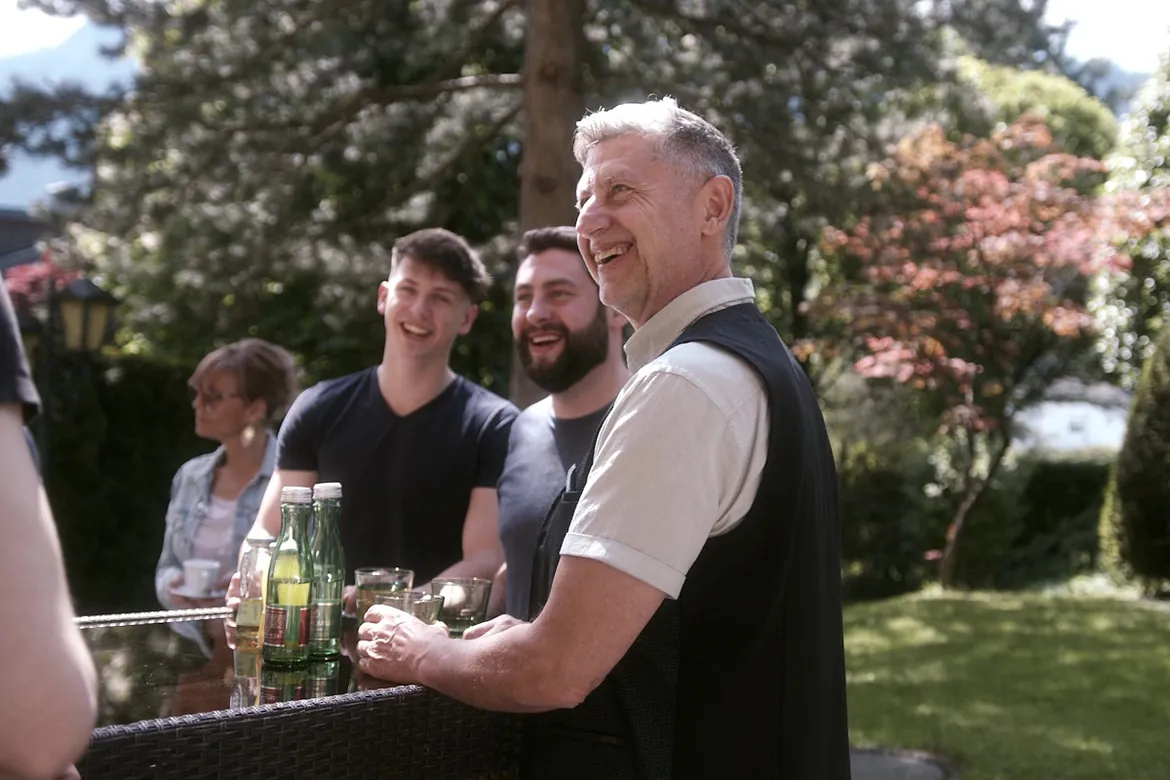
At Hotel Hubertushof Anif, we often observe how, after an intensive seminar day, teams begin sharing personal stories over dinner. Colleagues become conversation partners. New perspectives emerge.
These moments cannot be forced.
But the right framework can make them possible.
Why the right location is part of the concept
A team retreat is not only about content – the location itself communicates a message.
A purely functional business hotel signals efficiency.
An authentic venue with character signals appreciation.
When companies deliberately choose a place that stands for quality, regional identity, and calmness, they send a clear message:
This time matters. This team matters.
At Hotel Hubertushof Anif, we see ourselves as exactly this kind of host:
Professional seminar infrastructure
Personal support
Regional cuisine
A nature-oriented setting near Salzburg
Spaces for exchange and quiet reflection
Here, structure and human connection find balance.
Conclusion: Less agenda, more humanity
Perhaps the most important takeaway from our exchange with the experienced trainer:
“The strongest teambuilding moments are not created by programs – but by encounters.”
Sometimes one thoughtful question is enough.
One moment of attentive listening.
One shared laugh.
One meaningful story.
Teambuilding does not need to be loud.
It can be calm.
It can be personal.
It can be simple.
When teams take time to truly get to know one another, trust emerges.
And trust is the foundation of every successful collaboration.
If you are planning your next team retreat, do not only plan the agenda – plan for connection.
Choose a place that encourages conversation.
Create space instead of pressure.
Ask the questions that truly matter.
At Hotel Hubertushof Anif, we are happy to support you in creating exactly that kind of experience – because in the end, it is not the flipchart people remember.
It is the conversation.

Comments
Leave a comment